
The Future of Google’s AI Mode for Dental Marketing
Source: Dr. Marketing
The way patients search for dental care is changing. For years, dental marketing strategies have focused on helping practices rank for searches such as “dentist near me,” “dental implants in my city,” or “emergency dentist open today.” These searches are not disappearing, but Google’s AI Mode is creating a more conversational and personalized search experience.
Instead of entering several short queries and comparing multiple pages, a patient may ask Google a detailed question such as:
“Which dentist near me offers sedation for anxious patients, accepts my insurance, and has appointments available this week?”
Google’s AI Mode is designed to interpret complex questions, research related subtopics, compare information, and provide a comprehensive response supported by links. For dental practices, this means online visibility will increasingly depend on whether Google can understand the practice, verify its information, and connect its services with a patient’s specific needs.
At Dr. Marketing, we see this as an evolution of dental search marketing, not the end of traditional SEO. Practices will still need technically sound websites, strong local signals, useful content, accurate business information, and effective advertising. The difference is that all these elements must work together more clearly than ever.
What Is Google’s AI Mode?

Google’s AI Mode is an AI-powered search experience built for detailed questions, comparisons, follow-up questions, and research-intensive searches. It is different from an AI Overview, which may appear above conventional search results for certain queries. AI Mode provides a dedicated conversational environment where users can continue refining their questions. According to Google Search Central, AI Mode may use a process known as “query fan-out.” Google’s systems can issue multiple related searches across different subtopics and data sources before producing a response.
For example, a patient asking about the best way to replace missing teeth may prompt Google to research:
- Differences between dental implants, bridges, and dentures
- Typical candidacy requirements
- Treatment timelines and recovery
- Local dental practices providing each service
- Insurance, financing, and consultation information
- Reviews and other indicators of patient experience
The patient does not have to perform every search separately. AI Mode can organize the information into one response and provide supporting links for further exploration.
Google also states that there are no special technical requirements or exclusive AI schema needed to appear in AI Mode. A page must be indexed, eligible to appear in Google Search, and able to display a snippet. Traditional SEO fundamentals therefore remain essential.
Dental Searches Will Become Longer and More Specific
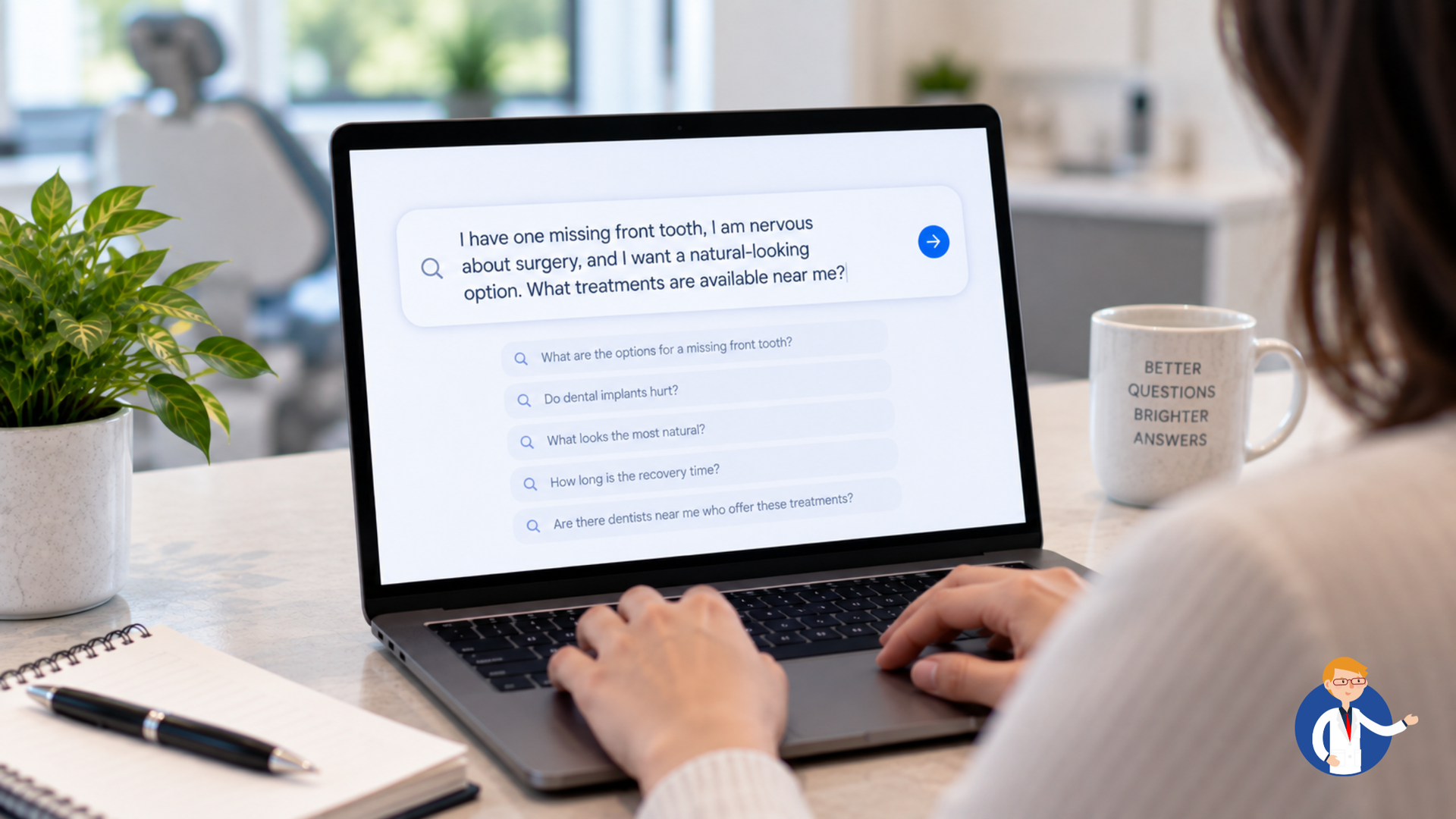
Keyword research has traditionally grouped patients around relatively short phrases, such as “Invisalign near me” or “dental implant cost.” In AI Mode, patients can explain their circumstances, preferences, and concerns in much greater detail.
A prospective patient could ask:
“I have one missing front tooth, I am nervous about surgery, and I want a natural-looking option. What treatments are available near me?”
This question reveals the condition, treatment concern, cosmetic goal, and local intent. A dental website built around only one broad keyword may not provide enough information to support a useful AI-generated response.
Dental content will need to address the complete decision-making journey. A strong implant page, for example, should explain candidacy, procedure steps, comfort options, expected recovery, alternatives, maintenance, costs, financing, and when an examination is necessary. The purpose is not to make every page unnecessarily long. It is to give patients clear answers to the questions that influence their decisions.
Being Cited May Become as Important as Ranking
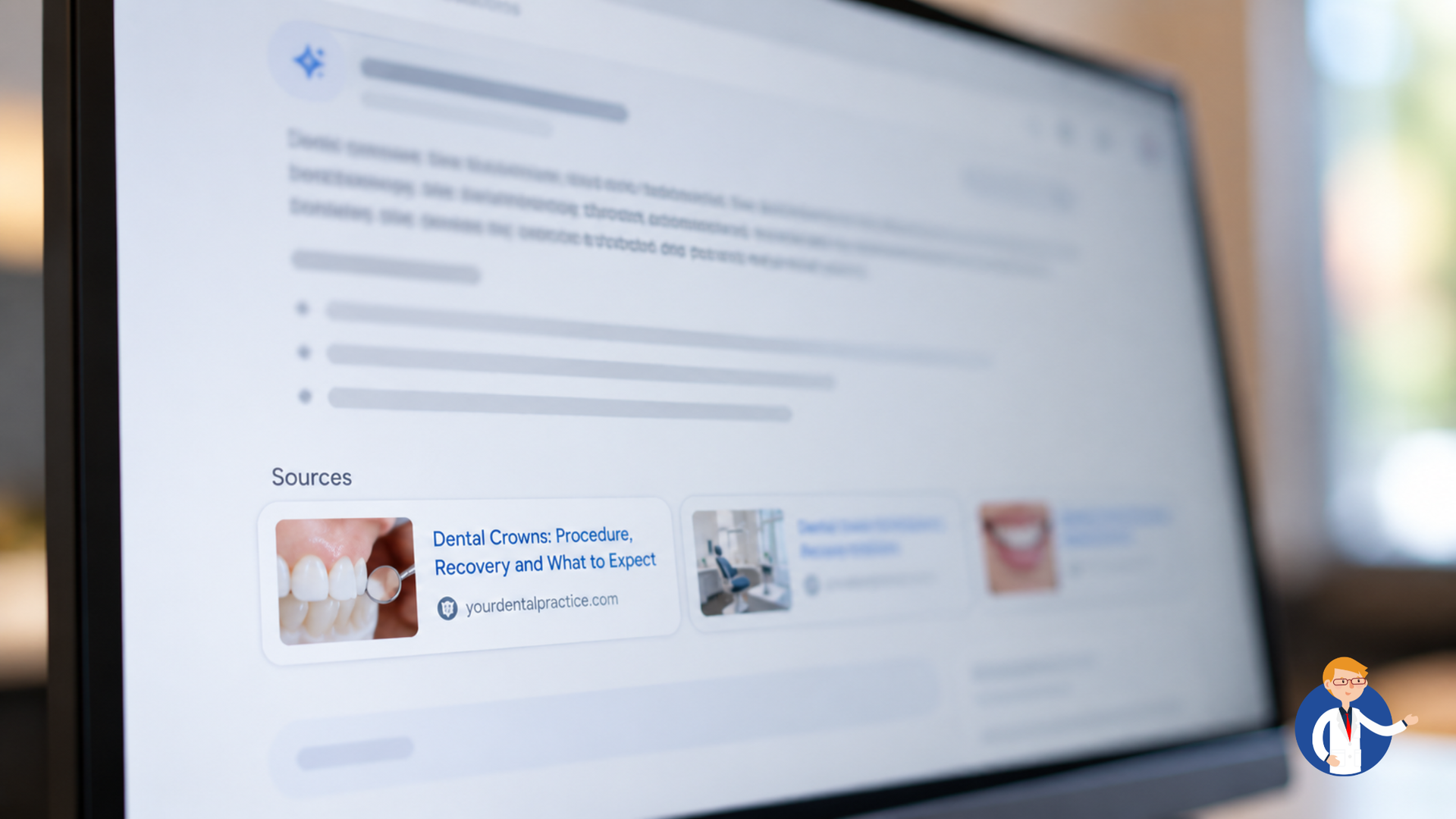
In conventional search, success is often measured by the position of a webpage. In AI Mode, a practice may gain visibility when its website is used as a supporting source or when its information helps Google form an answer.
This adds another goal to dental SEO: becoming a clear, reliable, and citable source.
Content that merely repeats generic dental definitions may struggle to stand out. Hundreds of websites already explain what a dental crown is. A more valuable page answers the practical questions patients ask, such as how long the visit takes, whether a temporary crown is needed, what symptoms require urgent care, and how the practice approaches treatment.
Originality will matter as well. Dentist-reviewed explanations, firsthand clinical perspectives, custom photographs, patient resources, detailed provider biographies, and transparent descriptions of the practice can strengthen trust. Because dental information can affect a person’s health decisions, accuracy and appropriate clinical review are particularly important.
Local Dental Visibility Will Depend on Consistent Business Information
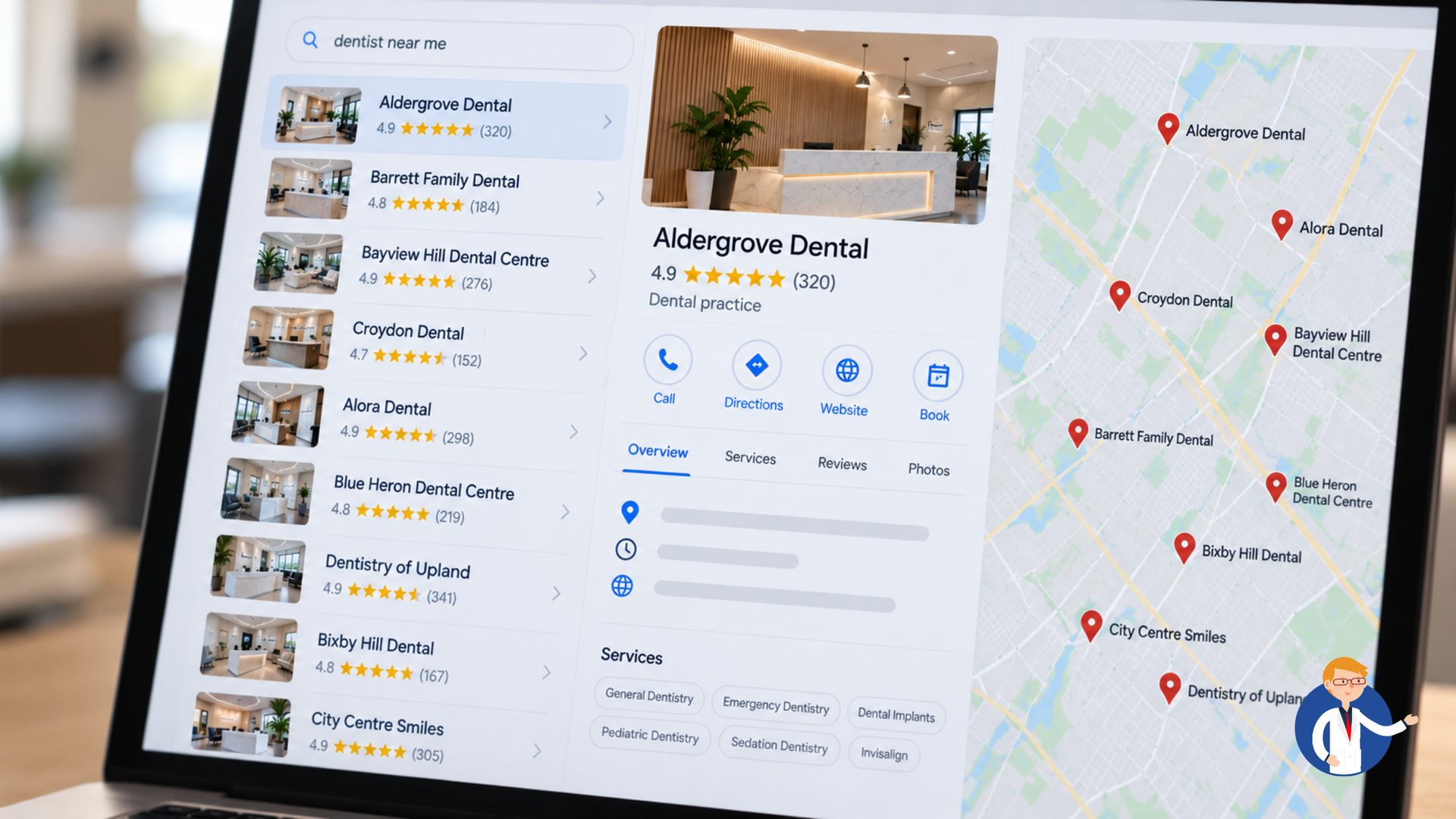
AI Mode does not eliminate local SEO. It makes accurate local information even more valuable.
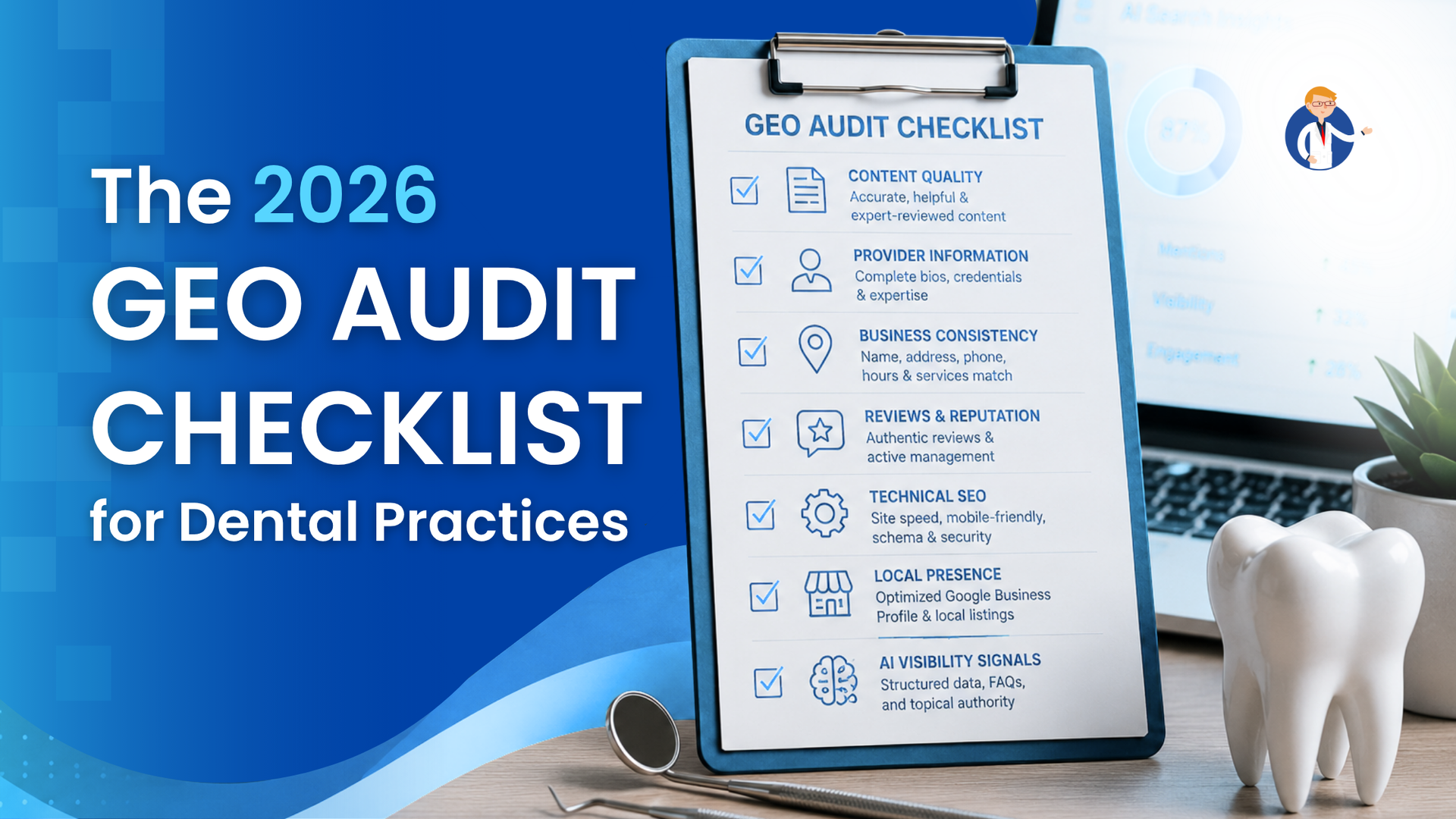
Google advises businesses to keep their Google Business Profile information current. Dental practices should ensure that their name, address, phone number, hours, website, categories, services, and appointment links are accurate across their website, Google Business Profile, directories, and other trusted platforms.
Service information must also be specific. If a practice provides emergency dentistry, dental implants, pediatric care, or sedation, those services should be clearly described on relevant pages. Google should not have to infer the practice capabilities from a single sentence on the homepage.
Reviews may also help prospective patients assess qualities that are difficult to understand from service pages alone, such as friendliness, communication, wait times, or support for anxious patients. Practices should continue requesting genuine feedback without offering prohibited incentives or attempting to control what patients say.
AI Mode May Move Search Closer to Patient Action
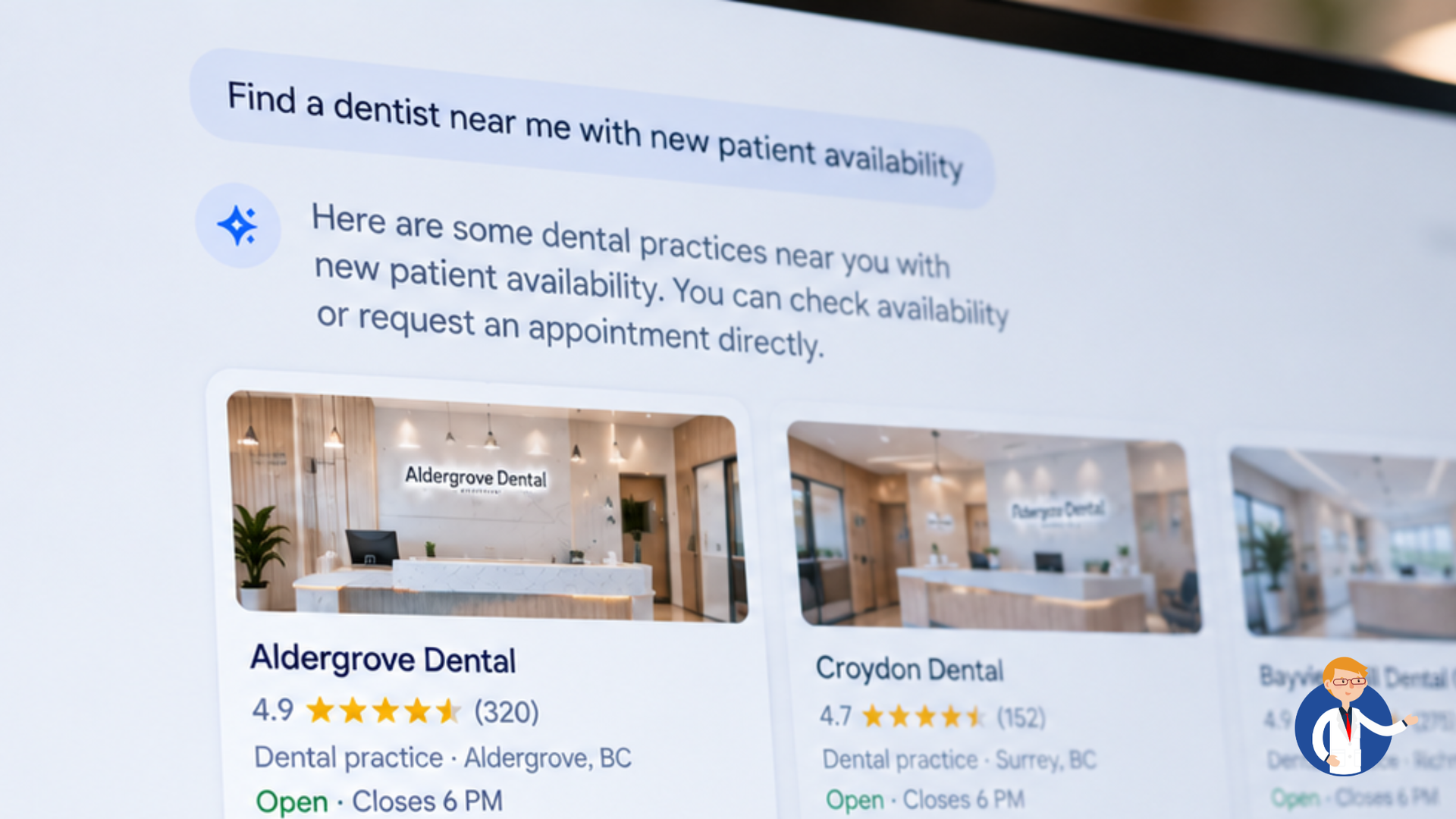
The future of AI search is not limited to summarizing information. Google has introduced AI Mode capabilities that can research certain local services, check availability, complete forms, and, in some situations, call businesses for information that is unavailable online.
This does not mean Google has guaranteed automated dental appointment booking for every market or practice. However, it clearly indicates a movement from information discovery toward action.
For dentists, the practical lesson is to make conversion information easy to find. Office hours, accepted insurance, financing options, new-patient availability, emergency policies, phone numbers, and appointment requests should be current and accessible.
Front-desk teams may also encounter more automated calls asking factual questions about services, pricing, or availability. Practices should establish clear, consistent answers and understand how Google’s automated calls are handled. If the website says one thing while the team provides another answer, both patient trust and search visibility may suffer.
SEO, AEO, and GEO Must Work Together
Dental practices should not treat SEO, answer engine optimization, and generative engine optimization as unrelated strategies.
SEO helps search engines crawl, index, understand, and rank webpages. AEO helps content provide direct answers to specific questions. GEO helps AI systems identify, interpret, and potentially cite information when generating responses. An effective page should serve all three purposes. It should target a relevant search topic, answer the patient’s central question early, and provide enough context and evidence to support a reliable response. Helpful practices include:
- Using descriptive headings based on real patient questions
- Providing a concise answer before expanding on details
- Adding dentist-reviewed FAQs where they genuinely help
- Naming the dentist, practice, service, and location naturally
- Supporting claims with reputable clinical sources
- Keeping structured data consistent with visible page content
- Connecting related service, condition, financing, and provider pages
- Updating content when treatment information or practice details change
Schema markup can help search engines understand certain page elements, but it does not guarantee inclusion in AI Mode. Google has explicitly stated that no special AI markup is required.
What Will Happen to Google Ads?

Organic visibility will remain important, but paid search is also becoming more automated. Google’s AI Max for Search campaigns can expand search-term matching, customize text, and select relevant landing pages using signals from practice ads, keywords, assets, and websites.
AI Max and AI Mode are separate products. AI Max is an optimization layer for Search campaigns, while AI Mode is a user-facing search experience. Still, they reflect the same broader shift toward interpreting intent rather than relying exclusively on exact keyword phrasing.
Dental advertisers will need stronger landing pages, reliable conversion tracking, carefully reviewed search terms, location controls, negative keywords, and clear service-specific messaging. Automation should be supervised. A system that expands reach can also waste budget when campaign structure, location settings, or conversion data are weak.
The future of dental advertising will not be completely hands-off. It will require marketers who understand how to give automated systems better input while protecting budget and lead quality.
How Dental Practices Can Prepare Now

Practices do not need to rebuild their entire marketing strategy for every new AI feature. They should strengthen the foundations that support visibility across both conventional and AI-powered search.
Start by auditing the website for thin, duplicated, outdated, or clinically unclear content. Build complete pages for priority services and connect them with relevant condition pages, doctor profiles, financial information, and location details.
Next, review the Google Business Profile and other important listings for accuracy. Improve tracking so the practice can measure calls, forms, online bookings, and qualified leads rather than relying only on rankings or clicks.
Google reports traffic from AI features within the Web search type in Search Console. As of its current documentation, AI Mode traffic is not always separated cleanly from all other organic search activities in standard reporting. Practices should therefore compare Search Console, Google Analytics, call tracking, and patient acquisition data to understand the larger trend.
Turning AI Search Visibility into Patient Growth

Preparing for AI Mode requires more than adding keywords or FAQs. Dental practices need accurate local information, helpful service pages, trustworthy content, and a clear path from search to appointment.
Visibility only matters when it attracts the right patients and encourages them to take action. At Dr. Marketing, we connect SEO, AEO, GEO, local optimization, Google Ads, and lead tracking into one practical strategy.
This helps dental practices become easier for search systems to understand while giving prospective patients the information and confidence they need to choose a provider and book an appointment.
Ready to grow your dental practice? Let’s talk.
Recent Posts