

The Role of Automated Follow-Up in Dental Growth

Source:
Dr. Marketing
Growing a dental practice involves more than attracting website visitors or generating inquiries. The practice must also respond to prospective patients, help them take the next step, and maintain communication with existing patients. When follow-up is inconsistent, even a successful dental marketing campaign can produce fewer appointments than expected.
A prospective patient might submit an online form, call after business hours, or ask about a particular treatment. If the practice does not respond promptly, that patient may continue searching and contact another office. Existing patients can also become inactive when recall reminders; appointment confirmations and treatment follow-ups are missed.
Automated follow-up helps dental practices address these communication gaps. It uses planned messages, reminders, and staff notifications to keep patient conversations moving without requiring the front desk to manage every step manually.
When used responsibly, automation does not replace personal communication. It handles routine actions so that the dental team can focus on questions, concerns, and situations that require genuine human attention.
What is Automated Follow-Up in Dentistry?
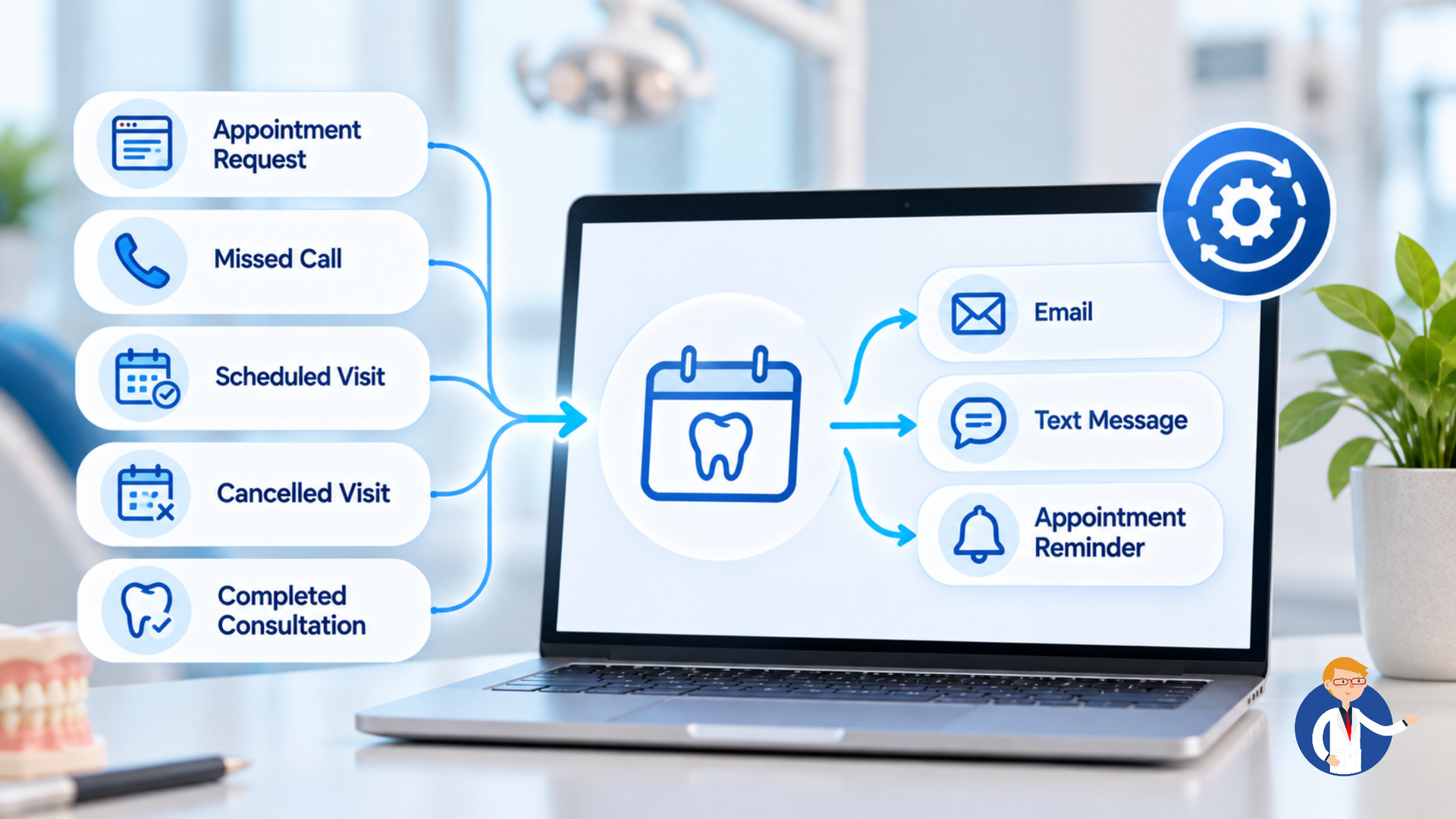
Automated follow-up is a system in which communication is triggered by a patient’s action, status, or scheduled event. The practice establishes the message, timing, and next step in advance. When the relevant action occurs, the system initiates the appropriate workflow. For example, automated communication may begin after someone:
- Submits an appointment request
- Calls the practice but does not book
- Schedules an appointment
- Cancels or misses a visit
- Completes a consultation
- Has an unscheduled treatment plan
- Becomes due for preventive care
- Has not visited the practice for an extended period
The follow-up might be an email, text message, appointment reminder, or internal notification for a team member. Some workflows are fully automated, while others use technology to alert the front desk that a personal call is needed. The purpose is not to automate every patient's conversation. It is to make sure that important opportunities are not forgotten simply because the practice is busy.
How Does Automated Follow-Up Help a Dental Practice Grow?

Automated follow-up supports dental growth by helping practices respond more consistently to both prospective and existing patients. It can improve the process between generating an inquiry and scheduling an appointment while also supporting recall, reactivation, and treatment coordination. The primary growth benefits include:
- Faster acknowledgment of new inquiries
- More consistent attempts to contact prospective patients
- Fewer preventable gaps in the schedule
- Better recall and patient reactivation
- Improved visibility into lead outcomes
- Less repetitive administrative work for the front desk
These improvements can help a practice get more value from its marketing. Increasing website traffic or advertising spend will not solve a weak follow-up process. If inquiries are not answered or tracked, the practice may continue losing potential patients regardless of how many leads it generates.
Responding to New Dental Leads More Consistently

Patients searching for a dentist often contact the practice because they have an immediate need. They might be experiencing pain, researching dental implants, considering cosmetic treatment, or looking for a new family dentist.
An immediate automated response can confirm that the practice received the inquiry and explain what the prospective patient should expect next. If the request arrives outside office hours, the message can let the person know when the team will respond.
The wording must be accurate. A confirmation that the practice received a request should not imply that an appointment has already been reserved. The message should clearly explain that a team member will confirm availability.
Automation can also create an internal task for the front desk. If the initial phone call is unanswered, the system may schedule another appropriate attempt. This helps prevent leads from being lost in spreadsheets, inboxes, or handwritten notes.
However, speeding alone is not enough. The response must be helpful, and the team must be prepared to continue the conversation. Automation can open the door, but a trained team member may still need to answer questions, explain scheduling options, and address concerns.
Reducing Missed and Cancelled Appointments
Missed appointments affect productivity, create unexpected openings, and may delay necessary care. Automated appointment reminders can give patients time to confirm, cancel, or reschedule before the appointment. The American Dental Association includes text messages and phone calls among its suggested strategies for reducing missed appointments. It also recommends confirming patient contact information regularly, so reminders are sent to the correct person. A reminder workflow may include:
- A confirmation when the appointment is scheduled
- A reminder several days before the visit
- A shorter reminder closer to the appointment
- Simple instructions for confirming or rescheduling
Practices should adjust the timing according to their cancellation policies and patient needs. Sending too many reminders can become frustrating, while sending one message too early may not be enough to prevent patients from forgetting.
Reminders should also be easy to act on. If patients cannot confirm or request a different time conveniently, the message may not solve the underlying scheduling problem.
Supporting Dental Recall and Patient Retention

Practice growth is not based entirely on new patient acquisition. Retaining existing patients and maintaining appropriate recall communication are equally important.
A recall system can identify patients who may be due for care and send a message encouraging them to contact the office. If the patient does not respond, the workflow can schedule another communication or alert a team member to call.
Recall messages should not assume that every patient requires the same appointment schedule. The appropriate frequency of dental visits depends on the individual’s oral health, risk factors, and clinical recommendations.
Automation can also help practices reconnect with inactive patients. These individuals may have moved, changed insurance, forgotten to schedule or delayed care for personal reasons. A respectful reactivation message can remind them that the practice is available without making assumptions about their current condition.
Maintaining these relationships can create a more stable appointment pipeline and reduce the practice’s dependence on continuously acquiring new patients.
Following Up on Unscheduled Treatment

Patients do not always schedule recommended treatment immediately. They may need time to consider costs, review insurance coverage, arrange transportation, or overcome dental anxiety.
A treatment follow-up workflow can thank the patient for visiting and provide a clear way to contact the practice with questions. It can also prompt a treatment coordinator to make a personal call after an appropriate period.
This process requires balance. Automated messages should not interpret diagnoses, create artificial urgency, or pressure patients into accepting care. Questions about treatment risks, benefits, alternatives, and expected outcomes should be answered by qualified team members.
Automation is most helpful when it identifies which patients require follow-up and supports the administrative process. Clinical communication and informed decision-making should remain with the appropriate dental professionals.
Improving the Patient Experience Through Clear Communication
Automation is often introduced as a productivity tool, but its effect on patient experience is equally important. Patients appreciate knowing that their request was received, when their appointment is scheduled, and what they need to do before arriving. Automated messages may include general directions, parking information, links to forms or instructions for contacting the office.
This communication can reduce uncertainty while saving the team from repeatedly sending the same information. Nevertheless, every message should reflect the practice’s tone. Robotic wording, irrelevant promotions, and excessive reminders can make the experience feel impersonal. Messages should be written in clear language and reviewed regularly to ensure that the information remains accurate.
The system should also make it easy for patients to reach a person. Automation becomes frustrating when it creates barriers between the patient and the dental team.
Using Technology to Manage Dental Follow-Up

As a practice generates more inquiries, managing follow-up through separate spreadsheets, inboxes and phone notes can become difficult. A dental customer relationship management system, commonly called a dental CRM, can help centralize lead information and communication activity. For example, Dentara is a dental CRM available through Dr. Marketing that includes lead management, automated workflows, integrated messaging, call recording, analytics, and reporting. These capabilities can help a practice track prospective patients from initial contact through conversion and see where follow-up may be breaking down.
Dentara is one part of the broader process. The results still depend on how the workflows are configured, how messages are written, and how reliably team members respond to assigned tasks. No CRM can compensate for unclear responsibilities or an inconsistent scheduling process.
Before selecting any follow-up technology, a dental practice should consider whether it can:
- Capture leads from the practice’s main marketing channels
- Show the status of each inquiry
- Record previous communication attempts
- Assign clear tasks to staff members
- Stop automated messages after a response or booking
- Report on leads, appointments and conversion outcomes
- Support the practice’s privacy and compliance requirements
The technology should fit the practice’s workflow rather than make communication more complicated.
Protecting Patient Privacy and Communication Preferences

Automated follow-up must comply with the privacy and communication requirements that apply to the practice location and message type.
In the United States, the Department of Health and Human Services states that appointment reminders are permitted under the HIPAA Privacy Rule. Practices must still use reasonable safeguards and limit the information disclosed.
Practices should also understand that HIPAA is not the only relevant requirement. Telephone, text message, and marketing communication may be subject to additional federal and state rules.
In Canada, commercial emails and text messages may fall under Canada’s Anti-Spam Legislation. The CRTC identifies consent, sender information and a working unsubscribe mechanism as key requirements for commercial electronic messages.
Before activating a workflow, practices should obtain appropriate consent, respect communication preferences, limit sensitive information and confirm that technology vendors provide suitable privacy protections. Legal or compliance professionals should be consulted regarding the requirements that apply to the practice.
How Should a Practice Measure Follow-Up Performance?
Lead volume does not tell the complete story. A dental practice may receive many inquiries but convert very few of them into completed appointments. Useful follow-up metrics include:
- Average response time
- Percentage of leads successfully contacted
- Appointment booking rate
- Completed appointment rate
- Missed appointment rate
- Recall reactivation rate
- Treatment follow-up outcomes
- Reasons patients do not schedule
These measurements help the practice understand whether the problem is lead quality, response time, scheduling availability, phone handling or another part of the patient journey.
Call recording and lead reporting may also help managers identify training opportunities. All recording and storage practices must comply with applicable consent, privacy, and recordkeeping requirements.
Create a Follow-Up Process That Supports Sustainable Growth

Automated follow-up can help dental practices respond to leads, protect valuable schedule time, and maintain relationships with existing patients. Its effectiveness, however, depends on more than simply installing software.
The practice needs clear workflows, thoughtful messages, trained team members, and meaningful performance tracking. Technology such as Dentara can make these processes easier to manage, but human communication remains essential whenever patients need guidance or reassurance.
At Dr. Marketing, we help dental practices look beyond lead generation and examine what happens after a potential patient makes contact. By connecting dental marketing with organized follow-up and conversion tracking, practices can make better use of their opportunities while creating a more responsive patient experience.
Ready to grow your dental practice? Let’s talk.
Recent Posts