

How to Create FAQ Content for Dental Website That AI Can Easily Understand
Source:
Dr. Marketing
Patients ask search engines and AI platforms for highly specific dental questions every day. They want to know whether a root canal hurts, how long dental implants last, whether Invisalign works for an overbite, or when a toothache requires emergency care. Increasingly, these questions are being entered into Google’s AI Mode, AI Overviews, ChatGPT, Gemini, and Perplexity instead of traditional search alone.
For dental practices, this shift creates an important content opportunity. A well-structured FAQ section can clearly communicate your expertise, answer patients’ concerns, and help search and AI systems understand the information on your website.
However, adding a long list of generic questions is not enough. FAQ content must be accurate, specific, easy to interpret, and genuinely helpful to patients. At Dr. Marketing, we approach FAQ creation as part of a broader SEO, answer engine optimization, and generative engine optimization strategy.
Why FAQ Content Matters in AI-Driven Search
Traditional search results typically provide a list of pages that may answer a query. AI-powered search experiences can instead combine information from multiple sources into a direct response.
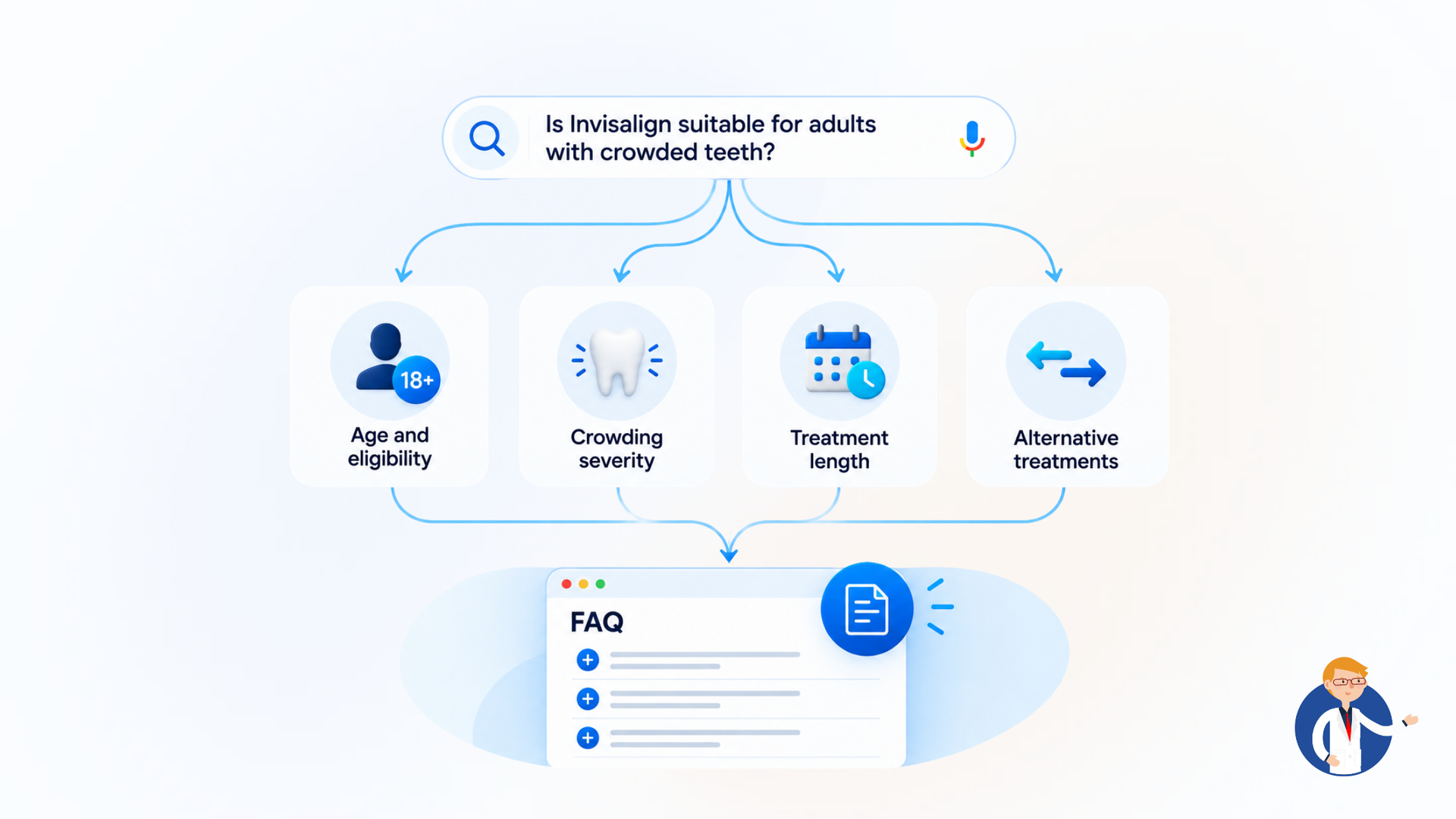
Google explains that AI Overviews and AI Mode may use a process called “query fan-out.” This means the system can perform several related searches across different subtopics before generating an answer. A patient asking, “Is Invisalign suitable for adults with crowded teeth?” may cause the system to explore related information about age, treatment eligibility, crowding severity, treatment length, and orthodontic alternatives.
FAQ content can support this type of discovery because it divides a broad dental topic into focused patient questions. Each question and answer creates a clearly defined information unit that search engines and AI systems can evaluate.
This does not mean that writing FAQs guarantees an AI citation or higher ranking. No platform guarantees inclusion. Strong FAQs simply make information easier to find, interpret, and use while supporting the quality of the page as a whole.
Begin With Questions Real Patients Ask

Effective FAQ content starts with patient needs, not a list of keywords copied from an SEO tool.
Dentists and front-desk teams already have access to valuable questions through phone calls, consultations, appointment requests, online forms, and patient conversations. Search Console queries, Google’s related searches, local competitor research, and keyword tools can reveal additional topics.
For example, a dental implant page could address questions such as:
- Am I eligible for dental implants if I have experienced bone loss?
- How long does the dental implant process take?
- Can dental implants replace several missing teeth?
- How should I care for a dental implant?
- Are dental implants covered by insurance?
These questions represent different concerns, including eligibility, treatment time, function, maintenance, and cost. Covering these distinct areas creates a more useful resource than repeating several variations of “What are dental implants?”
Write Questions in Natural Patient Language
FAQ headings should sound like questions a patient would genuinely ask. Avoid overly technical phrasing unless the terminology is commonly used by patients. For example:
Less helpful: What are the clinical indications for endodontic therapy?
Clearer: How do I know if I might need a root canal?
The second version uses familiar language while preserving the subject of the question. It is also closer to the conversational wording patients may use with voice assistants and AI platforms.
Include relevant dental terms naturally, but do not force every keyword of variation into the question. A clear question about “dental implants in Toronto” does not need to repeat “Toronto implant dentist,” “tooth implants Toronto,” and “dental implant clinic Toronto” in the answer.
Give the Direct Answer First
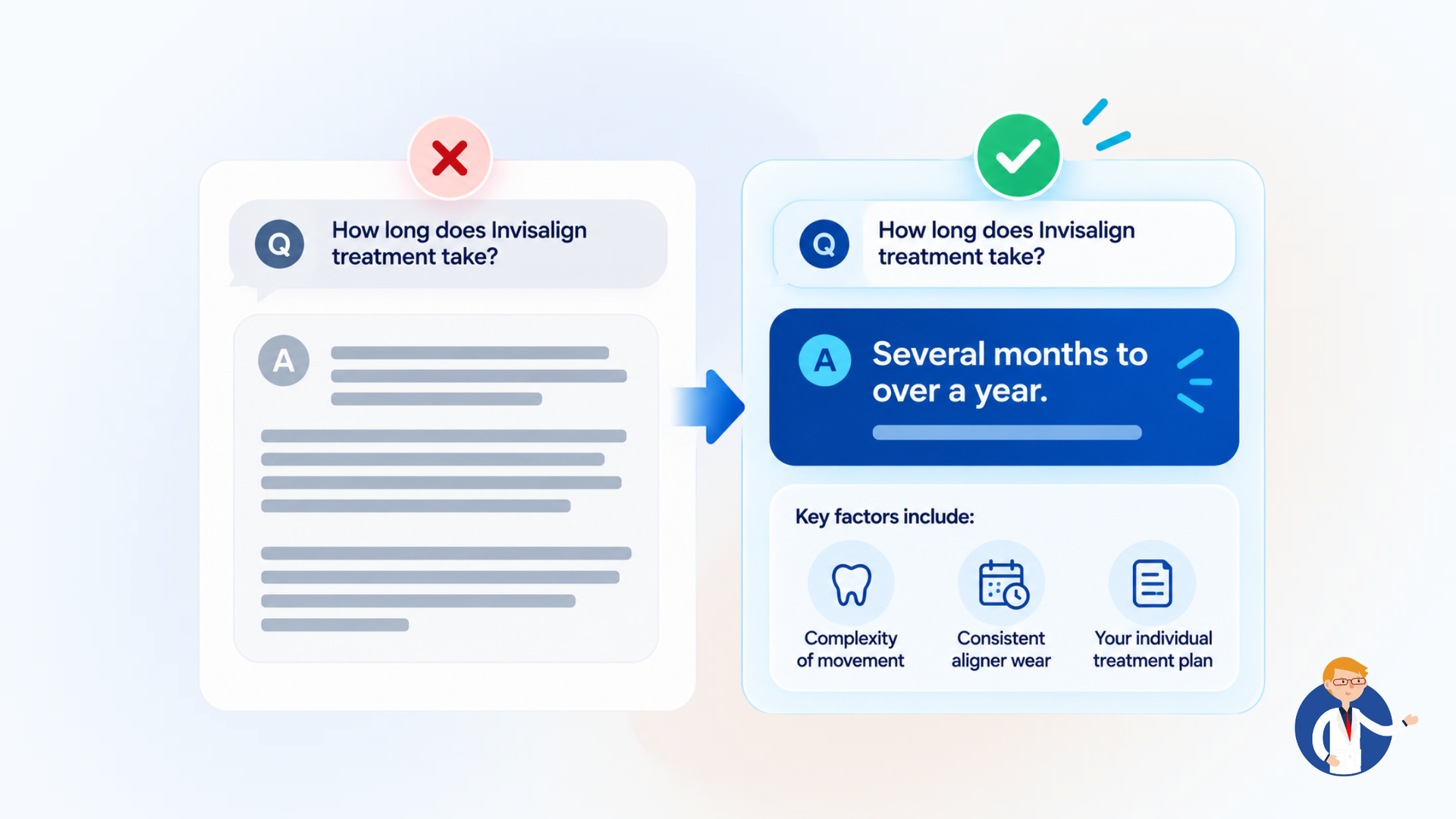
An AI-friendly answer should respond to the question immediately. Do not make patients read a long introduction before reaching the useful information. Consider this question:
How long does Invisalign treatment take?
A strong answer might begin:
“Invisalign treatment commonly takes several months to more than a year, but the timeline depends on the complexity of the tooth movement, how consistently the aligners are worn, and the individual treatment plan.”
The opening sentence provides a direct response. The next sentences can explain important conditions, exceptions, and the need for an assessment. This answer-first format also improves patient experience. Someone scanning the page can understand the main point quickly, while a patient who needs additional detail can continue reading.
Keep Each Answer Focused on One Question
A common mistake is placing several unrelated topics in one long answer. This makes the information difficult for both patients and automated systems to interpret.
If the question asks whether a procedure is painful, focus on comfort, anaesthesia, sensations, and recovery. Do not suddenly add an extended explanation about insurance, financing, candidacy, and appointment scheduling.
When a related topic requires more detail, create another FAQ or link to the appropriate service page. Clear separation helps establish the relationship between each question and its answer.
There is no universal ideal answer length. A straightforward operational question may need only two sentences. A health-related question may require a longer explanation to provide appropriate context. Clarity and completeness matter more than meeting an arbitrary word count.
Add Context Without Making Unsafe Promises
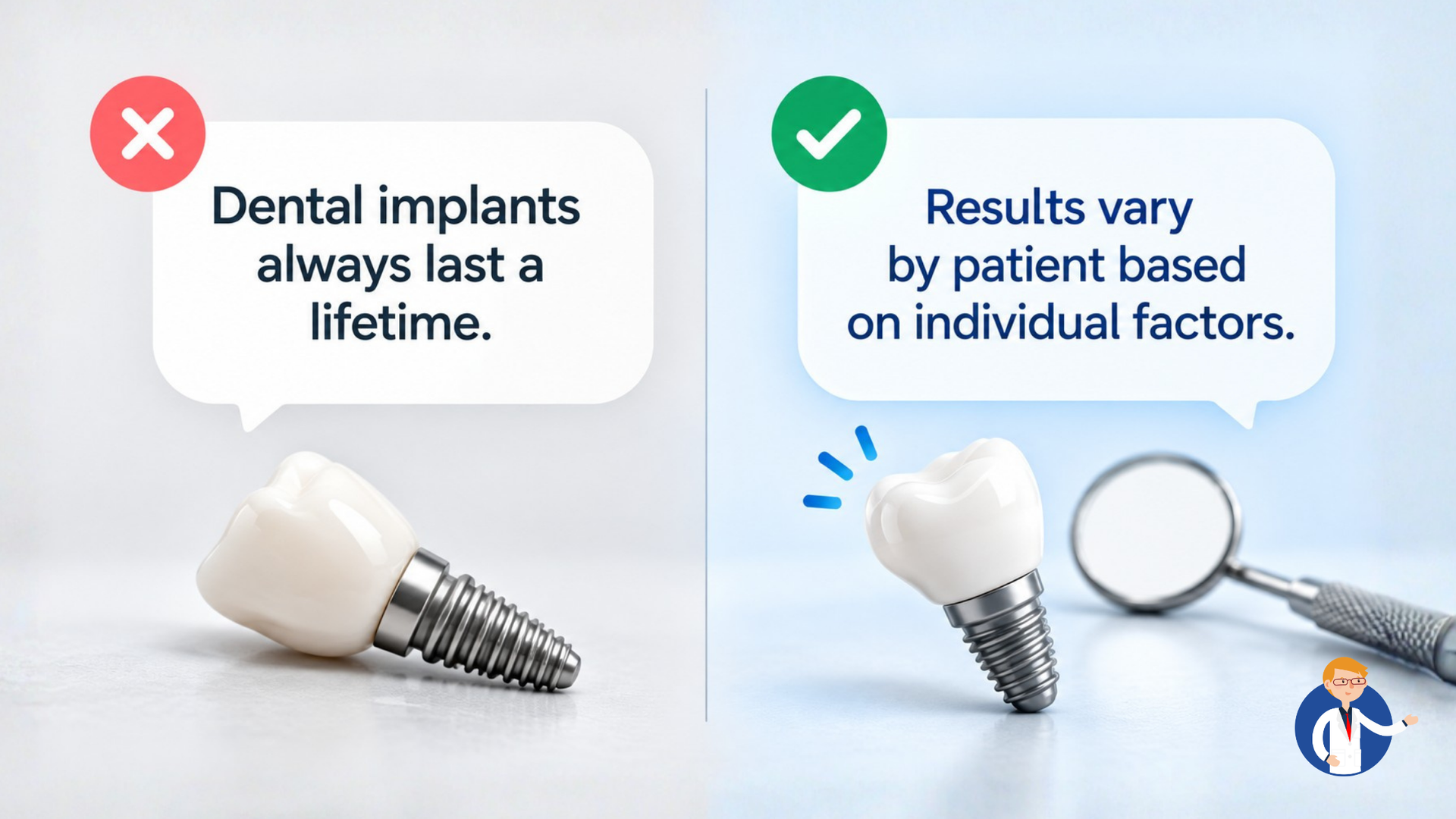
Dental content affects health decisions, so accuracy is particularly important. Avoid absolute promises such as:
- Dental implants always last a lifetime.
- Root canal treatment is completely painless.
- Invisalign can correct every orthodontic problem.
- Bleeding gum is nothing to worry about.
These statements ignore individual health factors and can mislead patients. Use responsible language that explains common outcomes without diagnosing the reader. For example:
“Mild sensitivity can occur after a dental filling and may settle as the tooth adjusts. Persistent, worsening, or severe pain should be evaluated by a dentist because it may indicate that the tooth needs additional care.”
This answer is understandable, medically responsible, and clear about when professional evaluation may be necessary.
Make Dental Expertise Visible
AI systems should not be expected to infer why a website is trustworthy. Help patients understand who created or reviewed the information. Dental FAQ pages can include:
- The name and credentials of the dentist who reviewed the content
- A short author or reviewer biography
- The original publication date and most recent review date
- Links to relevant professional or public health sources
- Clear information about the practice and its location
- Original explanations based on services the practice actually provides
Clinical claims should be reviewed by a qualified dental professional. This is especially important for content discussing symptoms, treatment candidacy, risks, recovery, and expected outcomes.
Adding a dentist’s name alone is not a substitute for accurate writing. The reviewer must assess the content.
Include Relevant Local Information

Generic FAQs may explain a service, but local questions help patients decide whether a particular practice can meet their needs. A dental practice can answer questions about:
- Whether it accepts new patients
- The communities or neighbourhoods it serves
- Insurance and financing processes
- Emergency appointment availability
- Accessibility and parking
- Languages spoken by the team
- Technologies available at the office
- Whether referrals are required for certain services
Local details should remain consistent across the website, Google Business Profile, directories, and other authoritative business listings. Conflicting phone numbers, hours, service descriptions, or addresses can confuse patients and weaken confidence in the information.
Use Clear Headings and Page Structure
A service page should have one descriptive main heading, followed by sections that progress logically through the topic. FAQs can appear near the end of the page or in a dedicated section when the topic requires extensive coverage.
Each question should be formatted as an actual heading rather than bold text buried inside a paragraph. The answer should appear directly beneath it.
Important information should also be available as readable text. Do not place essential answers only inside images, videos, or downloadable files. Google specifically recommends making important content available in textual form for its search and AI features.
FAQ accordions can improve page usability, particularly on mobile devices, but confirm that the content remains present in the page code and accessible to search crawlers.
Use Structured Data Carefully
Schema.org continues to define FAQPage, Question, and Answer structured data types. When a FAQ markup is used, it should accurately represent the visible questions and answers on the page.
Structured data can clarify page information for machines, but it should not be treated as a shortcut to rankings or AI citations. Google discontinued its FAQ rich result feature in May 2026 and subsequently removed the related Search documentation. Therefore, practices should not add FAQ schema with the expectation of receiving the former expandable FAQ search result.
Google also states that no special schema or AI-specific machine-readable file is required to appear in AI Overviews or AI Mode. The foundation remains in indexable, useful, reliable content supported by sound SEO.
Connect FAQs to the Rest of the Website

FAQ content should not become an isolated collection of answers. Use relevant internal links to connect patients with service pages, dentist biographies, financial information, emergency instructions, and appointment options.
For example, an answer to implant candidacy could link to the full dental implant service page. A question about payment could point to the practice’s insurance and financing page.
Use descriptive link text that identifies the destination. “Learn more about dental implant treatment” is more informative than “click here.”
Review and Update FAQs Regularly
FAQ information can become outdated when office policies, technologies, services, insurance participation, or professional guidance changes. Establish a review schedule and prioritize answers that affect patient decisions.
Use Search Console to identify new questions bringing people to the website. Review form submissions and call-tracking insights for recurring concerns. If patients repeatedly ask a question that the website does not answer, that question may deserve a new FAQ.
Performance should be evaluated through multiple signals, including relevant impressions, organic visits, engagement, calls, form submissions, and appointment requests. AI visibility can be monitored, but citations may fluctuate and should not be treated as a guaranteed or permanent placement.
Turn Patient Questions into a Stronger Search Strategy

FAQ content works best when it is accurate, answer-focused, locally relevant, and connected to a complete dental website. It should help a nervous or uncertain patient understand the next step, not simply provide more text for search engines to crawl.
At Dr. Marketing, we help dental practices identify meaningful patient questions, organize service content, strengthen local relevance, and create clear answers that support SEO, AEO, and GEO. As search continues to evolve, our focus remains the same: make each practice’s expertise easier for patients and search technologies to understand, trust, and act on.
Ready to grow your dental practice? Let’s talk.
Recent Posts