

How to Remove a Negative Google Review for Your Dental Practice
Source: Dr. Marketing
A negative Google review can have a significant impact on a dental practice. When prospective patients search for a dentist, your Google rating and recent reviews can influence whether they visit your website, call your office, or choose another practice.
Negative feedback is part of doing business, and not every negative review can be removed. However, what happens when a review appears to be fake, comes from someone who was never a patient, contains inappropriate information, or otherwise violates Google's policies?
Google may remove a negative review when it violates its content policies. Dental practices cannot delete patient reviews themselves, but they can report reviews to Google for evaluation.
This guide explains how dental practices can report a negative Google review, which policy violations may qualify for removal, how Google's Fake Engagement policy applies to reviews, how long the process can take, how to appeal a decision, and what dental practices need to consider before responding publicly.
Can a Dental Practice Remove a Negative Google Review?
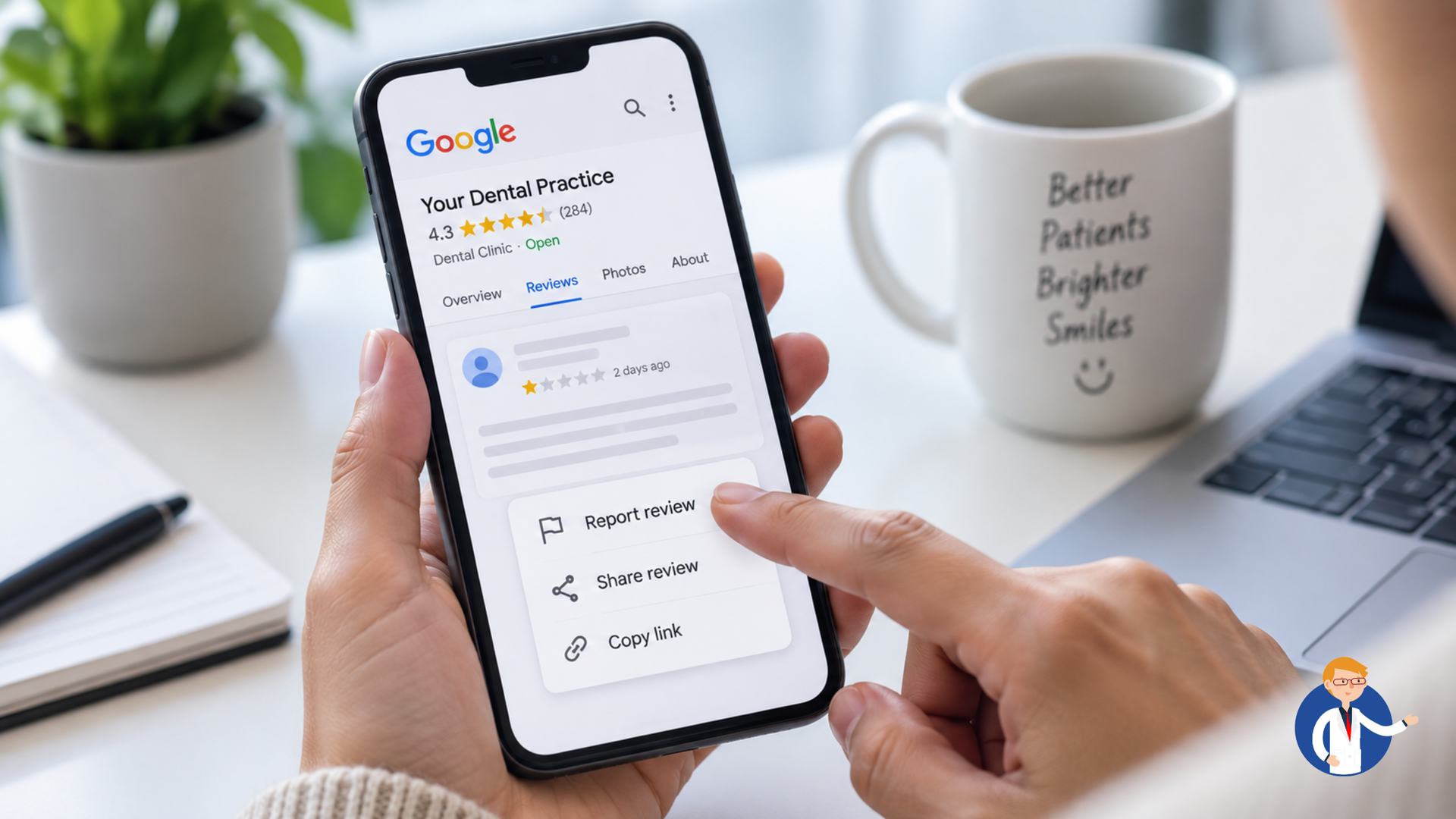
A dental practice cannot directly delete a review from its Google Business Profile.
Instead, the practice can report the review to Google if it appears to violate Google's policies. Google will evaluate the content and determine whether it should be removed.
Google makes it clear that businesses should not report a review simply because they disagree with it or dislike what was written.
For example, a patient may leave a one star review because they were unhappy with their wait time, treatment experience, billing, or interaction with the front desk. Even if the practice disagrees with the patient's account, the review may still be allowed.
The most important question is:
Does the review violate a specific Google policy?
If it does, your dental practice may have grounds to request its removal.
What Types of Google Reviews Can Be Removed?

Google has several policies governing reviews and other user generated content. For dental practices, the following violations are among the most important to understand.
1. Fake Engagement and Fake Google Reviews
Google's Fake Engagement policy is particularly relevant when a dental practice receives a suspicious review.
Google states that contributions to Google Maps should reflect a genuine experience with a place or business. Content that is not based on a real experience or does not accurately represent the business may be considered fake engagement. Google's policy also prohibits practices such as paying or incentivizing people for reviews, having content posted from multiple accounts at the request of one person, and posting reviews about a competitor to damage its reputation. For a dental practice, potential warning signs could include:
- A review from someone who appears to have never interacted with the practice
- Several suspicious reviews appearing within a short period
- Identical or nearly identical reviews from multiple accounts
- A review that discusses services your dental practice does not provide
- Reviews associated with a competitor or another clear conflict of interest
- A sudden pattern of reviews that appears intended to manipulate your practice's rating
However, there is an important distinction.
Not finding someone's Google display name in your patient management system does not automatically prove that a review is fake.
Patients may use nicknames, maiden names, shortened names, family accounts, or usernames on Google. A person also does not necessarily have to have completed or paid for dental treatment for an interaction with the practice to represent a genuine experience. When reporting suspected fake engagement, focus on all available evidence rather than simply stating that you cannot find the reviewer's name in your patient records.
2. Reviews From Competitors or People With a Conflict of Interest
Google's policies also address reviews involving conflicts of interest.
This may include content associated with current or former employment, professional relationships, competitors, family relationships, or other affiliations that could affect the independence of the review. For example, if a former employee leaves a one star review about the dental practice following an employment dispute, that information may be relevant when reporting the review.
Document any evidence that demonstrates the relationship.
3. Harassment or Threats
A patient is allowed to criticize a dental practice. However, certain threats, targeted harassment, doxxing, and other abusive behaviour may violate Google's policies.
There is an important difference between:
"I had a terrible experience and wouldn't recommend this dentist."
and content that threatens, intimidates, or targets a dentist or team member. When reporting the review, identify the specific content that you believe violates Google's policy.
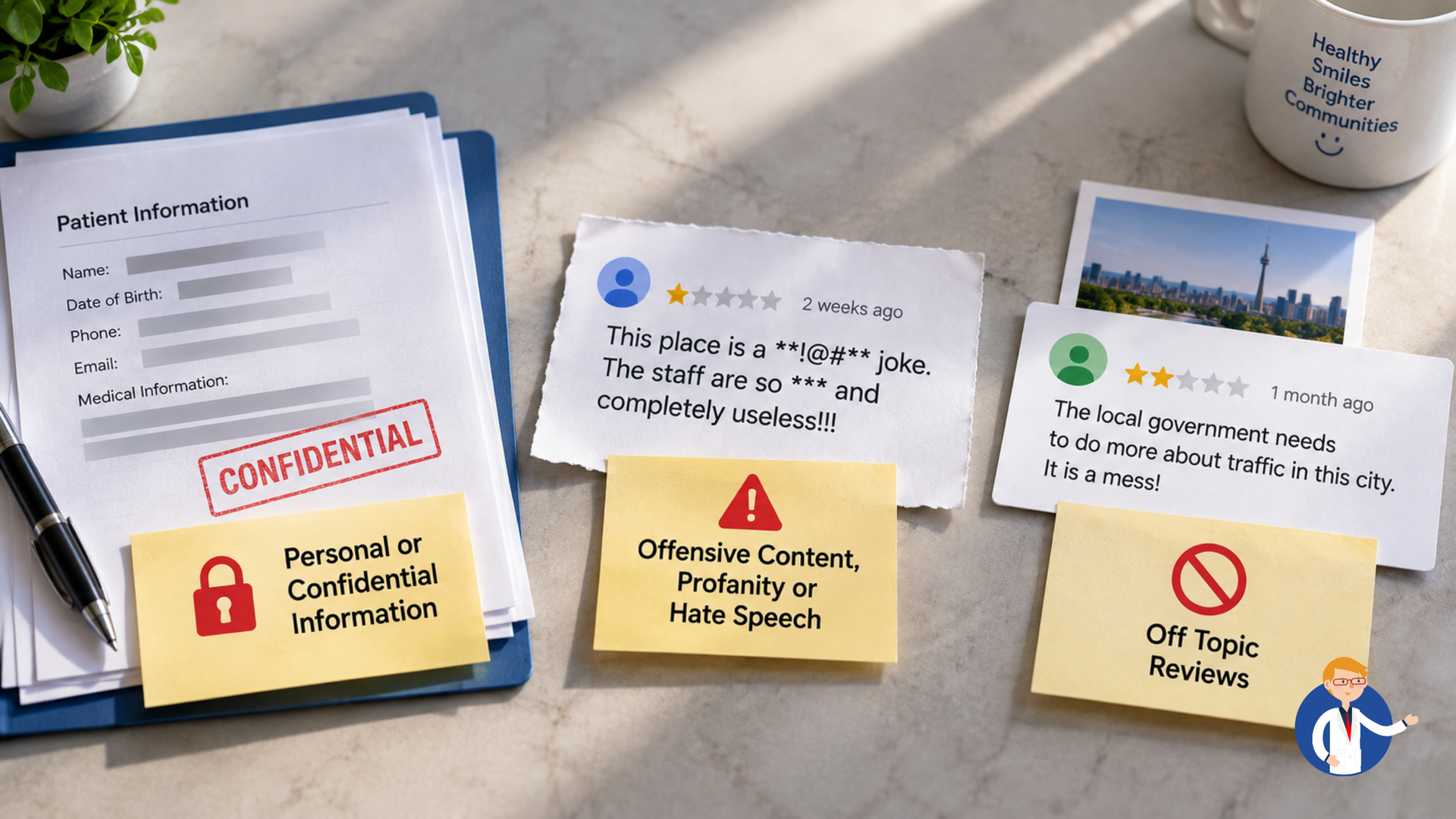
4. Personal or Confidential Information
Google restricts certain personal information from being published without consent.
This may include financial, medical, identification, and other sensitive personal information.
This category can be especially relevant to healthcare businesses. If a review publishes sensitive information about another patient, dentist, employee, or individual, review Google's personal information policy to determine whether the content should be reported.
5. Offensive Content, Profanity, or Hate Speech
Certain abusive, obscene, profane, or hateful content may violate Google's policies.
A negative opinion alone will generally not qualify.
For example, describing an appointment as "the worst dental experience I've ever had" is an opinion. Content containing prohibited attacks, threats, hate speech, or certain abusive language is a different matter.
6. Off Topic Reviews
Google expects reviews to relate to an experience with the specific business or location.
General political commentary, social commentary, personal rants, or content unrelated to an experience with the dental practice may violate Google's policies. This can become particularly important when a dental office receives negative reviews because of an unrelated online disagreement or controversy.

7. Spam, Advertising, or Solicitation
Google reviews should not be used to advertise another company or solicit business.
A review containing promotional content, unrelated commercial messaging, phone numbers, email addresses, social media accounts, or links intended to advertise another business may violate Google's policies.
8. Repetitive or Coordinated Reviews
Google does not allow repetitive content that reduces the usefulness of Google Maps.
This includes posting the same content multiple times from one account or across multiple accounts.
If your dental practice suddenly receives several identical or nearly identical reviews, document the accounts, dates, wording, and any other patterns you notice.
This information may help demonstrate that the reviews are part of coordinated activity rather than independent patient experiences.
A Note About Google's Fake Engagement Policy for Dental Practices

Google's Fake Engagement policy does not only apply to negative reviews. Dental practices also need to be careful about how they generate positive Google reviews.
Google allows businesses to encourage customers to leave reviews based on genuine experiences. However, practices should not attempt to manipulate the rating or content of those reviews.
For example, a dental practice should avoid offering discounts, gift cards, free products, contest entries, or other incentives in exchange for a review.
Practices should also avoid selectively asking only happy patients for Google reviews while intentionally discouraging dissatisfied patients from leaving feedback. Google also prohibits businesses from offering incentives in exchange for changing or removing a negative review.
A sustainable review strategy should focus on consistently asking real patients for honest feedback without attempting to influence what they say or what rating they provide.
How Do You Report a Google Review for Removal?
If you believe a review violates Google's policies, you can report it through your Google Business Profile. To report a Google review:
- Sign in to the Google account connected to your Business Profile.
- Find your dental practice's Google Business Profile.
- Select Read Reviews.
- Locate the review you want to report.
- Select the option to report the review.
- Choose the policy violation that most accurately describes the issue.
- Submit your report.
Google also provides a Reviews Management Tool where businesses can report reviews and monitor the status of previously reported reviews.
Choose the Most Accurate Policy Violation
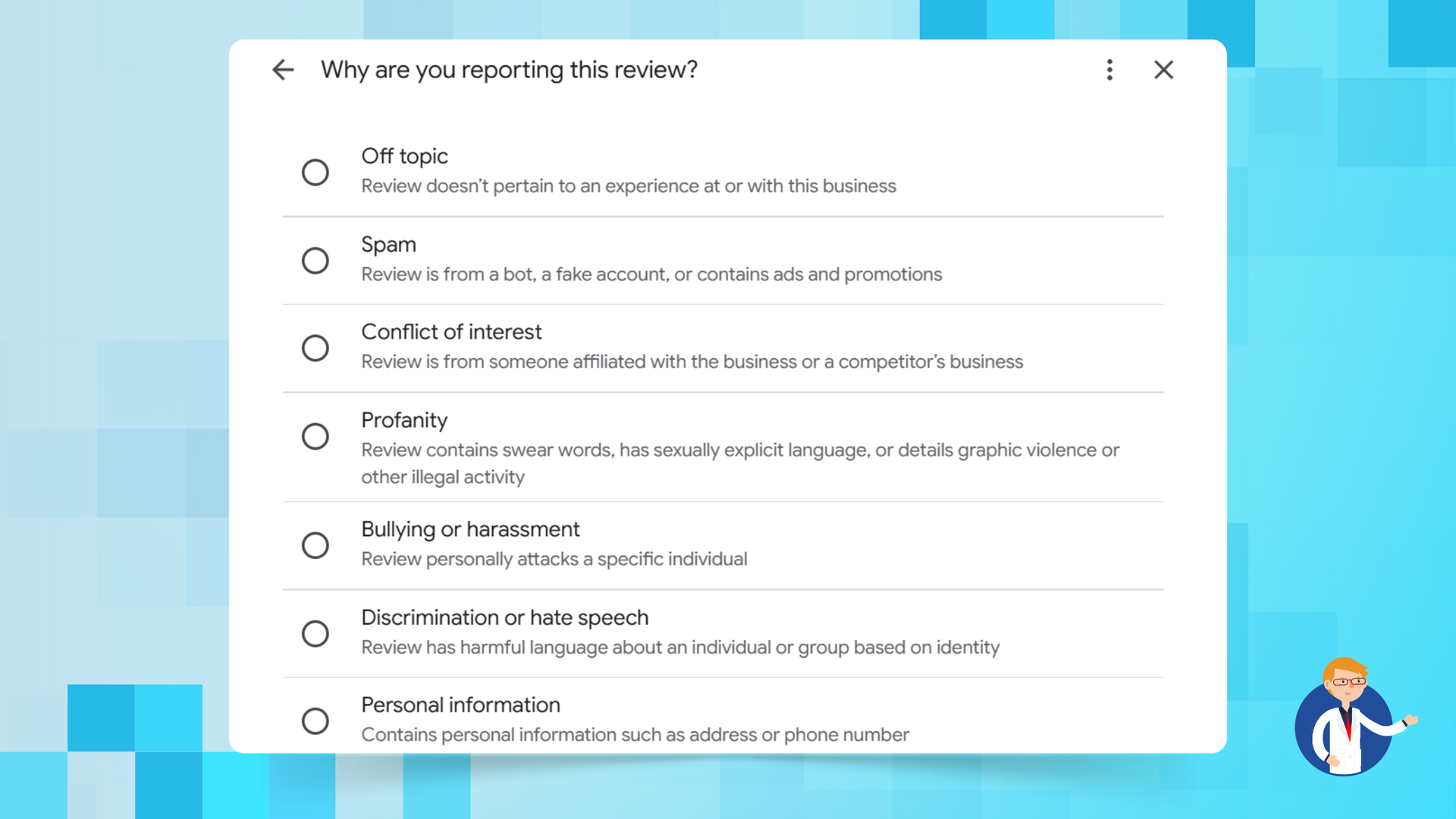
Do not choose a reporting category simply because it sounds serious. Your request should clearly connect the content of the review with the Google policy you believe it violates. For example:
- Former employee leaving a review: Potential conflict of interest.
- Several accounts posting identical reviews: Potential fake engagement or repetitive content.
- Reviewer discussing an experience that appears fabricated: Potential fake engagement.
- Sensitive personal information included in a review: Potential personal information violation.
- Review contains threats toward a dentist or employee: Potential harassment violation.
Keep your reasoning factual and specific.
How Long Does Google Take to Remove a Review?
Google states that review evaluations typically take several days.
You can monitor the status of your reported review using Google's Reviews Management Tool.
Depending on the situation, Google may determine that the review violates its policies and remove it, decide that there is no policy violation, or provide an opportunity for further appeal.
Avoid repeatedly submitting the same report while waiting for Google's initial decision.
What Are the Chances Google Will Remove a Negative Dental Review?

There is no guaranteed removal rate.
The likelihood of Google removing a negative review depends primarily on whether the content violates a Google policy.
A review may have a stronger case for removal when there is clear evidence of fake engagement, a conflict of interest, threats, prohibited personal information, hate speech, unrelated content, or coordinated review activity. Removal is generally less likely when a real patient is simply unhappy about:
- Wait times
- Pricing
- Insurance or billing
- Customer service
- Treatment expectations
- Scheduling
- Communication
- Their overall experience
Even when your dental practice believes the review is inaccurate or unfair, Google may allow it to remain if it represents the reviewer's genuine experience and does not otherwise violate its policies.
An unfair review is not necessarily a policy violating review.
What Should You Do if Google Refuses to Remove a Review?

If Google initially decides that the review does not violate its policies, eligible reviews may be submitted for an appeal.
Through Google's Reviews Management Tool, you can check the status of previously reported reviews and determine whether an appeal is available.
When submitting an appeal, focus on the policy violation rather than explaining how the review has negatively affected your practice.
Supporting information may include evidence of a conflict of interest, screenshots of coordinated reviews, examples of identical content posted from different accounts, or other documentation that supports the specific policy violation.
The goal is to show why the review violates Google's policy, not simply why you believe the reviewer is wrong.
Should Multiple People Report the Same Google Review?
Some businesses attempt to have several employees, friends, or other people report the same review from different devices in hopes that Google will remove it faster.
Google does not state that receiving more reports makes a review more likely to be removed.
In fact, Google's Fake Engagement policy specifically addresses content posted from multiple accounts at the request of one person and other attempts to manipulate genuine engagement.
For that reason, dental practices should not rely on coordinated mass reporting as a review removal strategy.
Instead, identify the legitimate violation, report the review correctly, document your evidence, monitor Google's decision, and appeal when appropriate.
HIPAA and Responding to Negative Google Reviews

For dental practices in the United States, there is another important consideration when managing Google reviews: HIPAA. Responding to a negative patient review can create privacy risks if your response reveals protected health information.
A patient choosing to publicly discuss their dental treatment does not automatically give the dental practice permission to disclose additional protected health information in response. This means you should be extremely careful about confirming details such as:
- Whether the reviewer is a patient
- When they visited the practice
- What treatment they received
- Their diagnosis or dental condition
- Their insurance or billing information
- Conversations they had with the dentist or team
- Details contained in their patient record
Even a response intended to defend the practice can create a problem. For example, avoid responses such as:
"You came to our office three times and refused the treatment Dr. Smith recommended."
Even if the statement is accurate, it may disclose information about the individual's relationship with the practice and their care.
The U.S. Department of Health and Human Services has previously taken enforcement action against healthcare providers, including a dental practice, for improperly disclosing protected health information while responding to online reviews.
How Should a Dental Practice Respond?
Keep your response general and professional. You might say:
"Thank you for sharing your feedback. Our practice takes concerns seriously and is committed to providing a positive experience. We encourage you to contact our office directly so that we can discuss your concerns privately."
This allows the practice to acknowledge the review without publicly discussing the individual's patient status, treatment, or health information.
Canadian dental practices should similarly follow the applicable federal and provincial privacy requirements governing patient information
Should You Respond While Waiting for Google to Review the Report?
In many situations, yes. Review removal is not immediate, and prospective patients may see the review while Google is evaluating your report.
A professional response can show potential patients that your practice takes concerns seriously. Keep the response brief, respectful, calm, and free of confidential information.
For healthcare practices, protecting patient privacy should take priority over publicly proving that the reviewer is wrong.
Can a Dental Marketing Company Remove a Google Review?
No legitimate dental marketing company can guarantee that Google will remove a negative review.
Google ultimately makes the removal decision.
However, a dental marketing company can help your practice identify potential policy violations, report inappropriate reviews, prepare appeals, monitor your Google Business Profile, develop appropriate review responses, and build a long term reputation management strategy.
Be cautious of any company promising guaranteed Google review removal.
Frequently Asked Questions About Removing Google Reviews for Dental Practices
Can a dentist delete a patient's Google review?
No. Dental practices cannot directly delete patient reviews. A review can be reported to Google when there is reason to believe it violates Google's policies.
Can Google remove a fake review from a dental practice?
Yes. Content that is not based on a genuine experience may violate Google's Fake Engagement policy. However, the practice should provide as much objective evidence as possible rather than relying solely on not recognizing the reviewer's Google name.
Can a former employee leave a Google review?
Reviews involving current or former employment may present a conflict of interest under Google's policies and may qualify for removal depending on the circumstances.
Can Google remove a one star dental review?
A one star rating alone is not grounds for removal. The review or rating must violate Google's policies.
Can a dental practice respond to a negative review under HIPAA?
Yes, but U.S. dental practices must be careful not to disclose protected health information in their response. Avoid confirming patient status, treatment details, appointments, diagnoses, billing information, or other protected information.
How long does Google take to remove a review?
Google states that review evaluations typically take several days. Appeals and more complicated cases may take longer.
What happens if Google rejects the removal request?
Check Google's Reviews Management Tool to determine whether the review is eligible for an appeal. If it is, submit your appeal with information supporting the specific policy violation.
Protect Your Dental Practice's Online Reputation

A negative review can be frustrating, particularly when you believe it does not accurately represent your practice. However, not every negative Google review can be removed.
The most effective approach is to understand Google's policies, identify legitimate violations, report inappropriate content correctly, protect patient privacy when responding, and consistently generate authentic feedback from real patients.
A strong reputation management strategy is not about eliminating every negative comment. It is about building an accurate and trustworthy online presence that reflects the quality of your dental practice.
Need Help Managing Your Dental Practice's Google Reviews?
Managing Google reviews, your Google Business Profile, and your practice's overall online reputation can become time consuming.
Dr. Marketing helps dental practices strengthen their Google presence, manage their online reputation, improve local visibility, and attract the right patients.
Contact Dr. Marketing to learn how we can help your practice build a stronger online presence.
Ready to grow your dental practice? Let’s talk.
Recent Posts