

Dental Marketing With AI: How to Build a Real Content Workflow
Source: Dr. Marketing
Most dental practices know content matters. Blogs support SEO , social media builds familiarity, and educational pages help patients feel more confident before booking. The issue is not motivation. The issue is consistency.
In many dental practices, content gets created only when someone has spare time. A blog is published when rankings slip. A post goes live when the front desk has a quiet moment. Even when the content is decent, it is usually disconnected and irregular, which makes SEO growth harder than it needs to be.
AI can help, but only if you use it as part of a workflow. AI is not a strategy, and it is not a replacement for dental expertise. What it can do is speed up the slowest parts of content creation, so your practice can publish useful, search-friendly content consistently without burning out staff.
This guide walks through a realistic, repeatable content creation workflow for a dental practice using AI, including planning, outlining, drafting, SEO cleanup, repurposing, and ongoing improvement.
Why Dental Practices Need a Workflow (Not Just “More Content”)
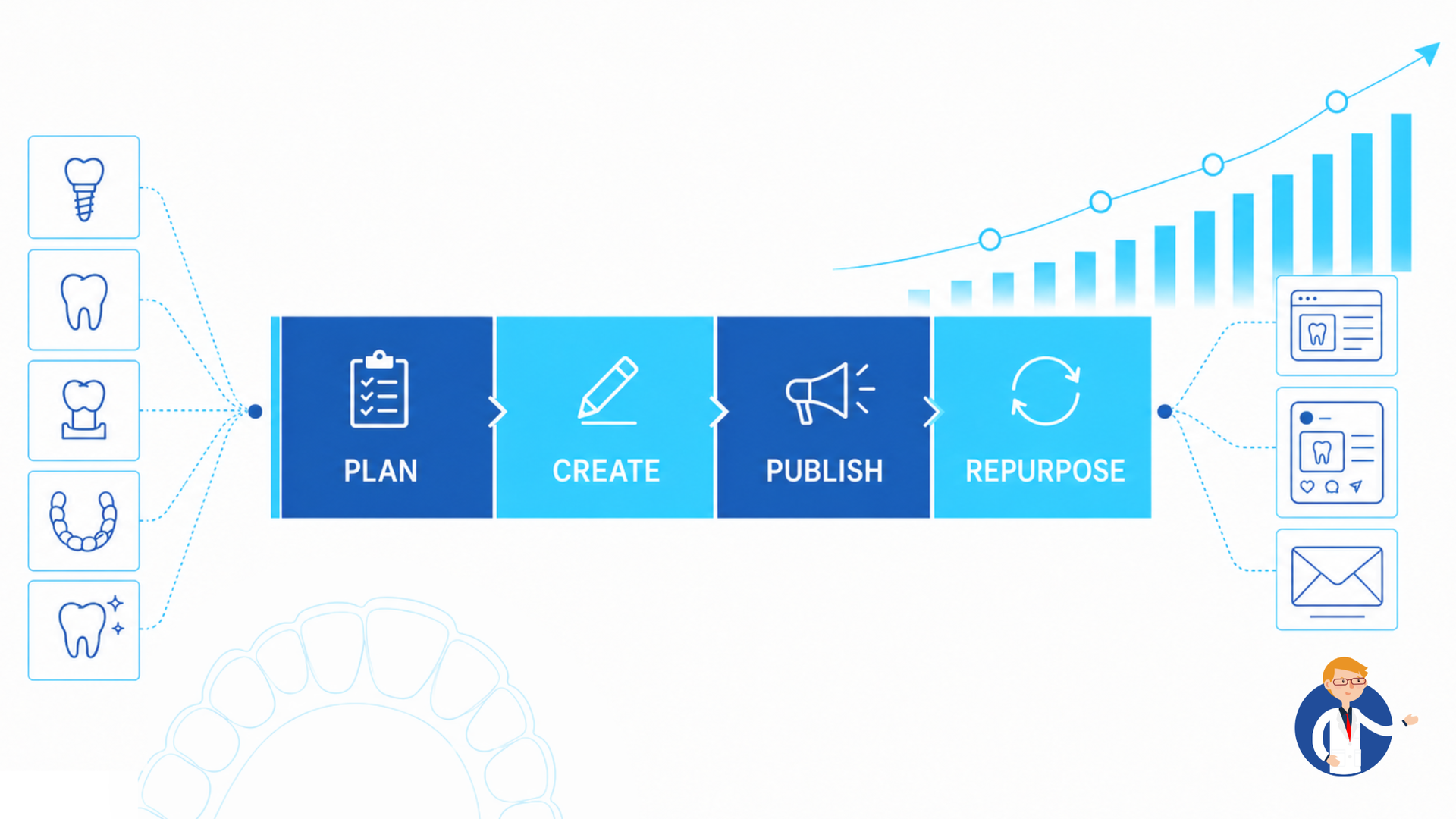
A dental practice that publishes one blog about teeth whitening, then nothing for two months, then a post about Invisalign, then a holiday graphic is not building authority. Search engines reward topical depth and consistency. Patients also trust dental practices that explain things clearly and show up regularly. A workflow creates structure, so content is not dependent on spare time. It turns content from a stressful task into a repeatable system.
A strong workflow helps your dental practice:
- Create content that supports priority services like dental implants, emergency dentistry, crowns, Invisalign, and teeth whitening, so your marketing effort ties directly to what you want to grow.
- Reduce decision fatigue by using a repeatable calendar, so you are not reinventing topics and formats every month.
- Improve SEO by building topic clusters that strengthen service pages through internal links and related supporting content.
- Maintain consistent messaging across your website, blog, social media, and email, which makes your dental practice sound more credible and cohesive.
- Repurpose each blog into multiple supporting pieces so one strong article fuels weeks of marketing without extra writing.
Once this structure is in place, AI becomes genuinely useful because it supports a system instead of generating random output.
Step 1: Choose the Services Your Dental Practice Wants to Rank For
Before you use AI, decide what content you should focus on. Most dental practices get the best results when they start with three to five priority services that are both high-value and commonly searched, such as dental implants, emergency dentistry, Invisalign, teeth whitening, dentures, root canals, crowns, or veneers.
This step matters because AI can generate endless content ideas, but without priorities, your dental practice will publish content that does not support your revenue goals or your SEO goals. A service-first approach helps you:
- Focus on content that attracts the right patients, not just traffic.
- Build a clear website structure where supporting blogs link back to service pages.
- Create depth around a few key services instead of spreading content too thin.
Once your priority services are clear, you can build a content system that compounds.
Step 2: Use AI to Build Topic Clusters Around Each Service
One of the fastest ways to improve dental SEO is to create topic clusters. This means you do not write one blog per service and stop. You create multiple supporting articles that answer different questions people search for around that service.
AI makes this faster by generating topic angles and common questions quickly. Your practice still chooses the best topics, but you do not start from zero. For example, if your dental practice wants to grow dental implant traffic, a topic cluster might include:
- A patient-friendly explanation of how dental implants work, including what the implant post does, how the crown fits, and why implants differ from bridges or dentures.
- A detailed guide to dental implant cost factors that explains why prices vary, what influences treatment plans, and what patients should ask during a consultation.
- A realistic recovery timeline article that explains healing stages, what is normal after surgery, and when patients can return to everyday routines.
- A comparison article that explains implants vs bridges vs dentures in practical terms, focusing on function, maintenance, and long-term durability.
- A candidacy-focused article that explains bone loss, whether bone grafting may be needed, and what options exist if implants are not suitable.
This approach improves SEO because you are building depth and showing expertise across multiple search intents, not just repeating the same service summary.
Step 3: Outline First (This Is Where AI Helps the Most)

If you want AI content that does not feel generic, outlining is non-negotiable. Asking AI to write a full blog immediately often leads to shallow content that repeats itself. Instead, use AI to generate a detailed outline that matches search intent. Search intent is the reason someone is searching. Are they comparing options, worried about pain, looking for cost information, or trying to understand a procedure?
A strong outline should include:
- An intro that addresses the real patient question, not a vague definition.
- Clear headings that expand the topic logically instead of circling the same point.
- A “what to expect” section because patients search for timelines, steps, and outcomes.
- A section that addresses common questions or misunderstandings.
- A conclusion that naturally guides next steps, such as booking a consult.
For example, a
teeth whitening blog should cover why teeth stain, why strips sometimes fail, what results are realistic, how long whitening lasts, what to avoid after whitening, and when whitening is not recommended. This outline step is what makes the final blog feel informative and content-heavy.
Step 4: Draft With AI, Then Apply a Simple Review Process
Once the outline is approved, AI can draft the blog quickly. This is where dental practices save time. But dental practices should not publish AI drafts without review. Dental topics sit close to healthcare, so accuracy and responsible wording matter. A clean review workflow keeps quality high without making content creation slow.
A practical review process looks like this:
- A medical reviewer confirms accuracy, including timelines, procedure descriptions, candidacy notes, and what your dental practice actually offers. This can be quick if the outline is strong.
- A marketing editor improves clarity and flow, tightens repetitive sections, and ensures the main keyword appears naturally in key places like the title, headings, intro, and conclusion.
- A final polish pass removes awkward AI phrasing and ensures the tone sounds like a real dental practice speaking to real patients.
This keeps your content trustworthy and prevents the “generic dental blog” feel that does not convert.
Step 5: Strengthen SEO Without Keyword Stuffing

SEO is not about repeating the keyword again. It is about covering the topic thoroughly and using related dental language naturally. AI can help improve this by suggesting related terms and improving headings and subheadings.
For example, a dental implant blog should naturally include related terms like implant crown, bone loss, healing stages, and alternatives like bridges or dentures where relevant. AI can also help you add internal links, which is one of the easiest SEO wins for dental sites. A blog about
dental implants should link to the implant service page and, when applicable, related pages like dentures, crowns, or bone grafting. To keep SEO clean and readable, your content should:
- Use the main keyword in the title and early in the intro.
- Use related keywords naturally in headings and explanations.
- Include internal links that help readers and strengthen site structure.
- Avoid filler paragraphs that do not add new information.
When the content is genuinely useful, SEO becomes easier.
Step 6: Repurpose One Blog Into Weeks of Content
Most dental practices waste content by publishing it once and moving on. AI makes repurposing fast, which helps dental practices stay consistent without constantly writing.
A single dental blog can become multiple supporting pieces across platforms. This is how you get more ROI from every article. A good repurposing workflow includes:
- Social posts that highlight one takeaway at a time, such as a common misconception, a quick tip, or a “what to expect” point pulled from the blog.
- Website FAQ content that can be added to service pages to support SEO and reduce patient hesitation before booking.
- Email newsletter snippets that summarize the blog and drive traffic back to your website.
- Google Business Profile posts that reinforce local relevance and keep your listing active.
This step turns one strong blog into a full month of supporting content without adding extra writing time.
Step 7: Make the Workflow Repeatable Each Month

The most important part of this system is that it can be repeated. Your dental practice does not need a complicated process. It needs a realistic one.
A sustainable monthly workflow often looks like: choose topics, outline, draft, review, optimize, repurpose, schedule. AI reduces the time required at every stage, so the dental practice can keep publishing without relying on last-minute effort.
Consistency is what drives SEO growth. A dental practice that publishes one strong blog every month and supports it with repurposed content will usually outperform a dental practice that publishes sporadically, even if the sporadic content is good.
Step 8: Improve Over Time Using Real Performance Data
AI workflows improve when you use feedback. Track which blogs bring traffic, which topics generate calls, and which pages are climbing in rankings. Then use those insights to guide your next topics.
AI can help summarize what is happening and suggest next steps, but the strategy is still human-led. The goal is to build a feedback loop where your content gets more targeted and more effective over time.
Final Thoughts: AI Helps Dental Practices Build Systems, Not Shortcuts

AI can absolutely help dental practices create content faster. But speed is not the hard part anymore. The hard part is creating content that is consistent, accurate, SEO-focused, and tied to the services your dental practice wants to grow.
That is why most dental practices do not struggle with “writing.” They struggle with building a content system they can stick to month after month.
This is where we make the biggest difference. Instead of simply generating AI content, we help your dental practice build a workflow that is structured, repeatable, and aligned with real patient search intent. That includes choosing the right topics based on services and keywords, creating strong outlines before writing begins, keeping messaging consistent across your website and social platforms, and making sure everything is reviewed for accuracy and tone.
The real win is not publishing more blogs. The win is publishing the right content consistently and getting more value out of every piece. When AI is used inside a real workflow, one strong blog can support SEO, feed social media, strengthen service pages, and answer patient questions before they ever call your office.
Used properly, AI does not replace dental marketing. It makes dental marketing easier to execute. And with the right strategy and oversight, it becomes one of the most efficient ways for dental practices to grow visibility without putting more pressure on their internal team.
Ready to grow your dental practice? Let’s talk.
Recent Posts